
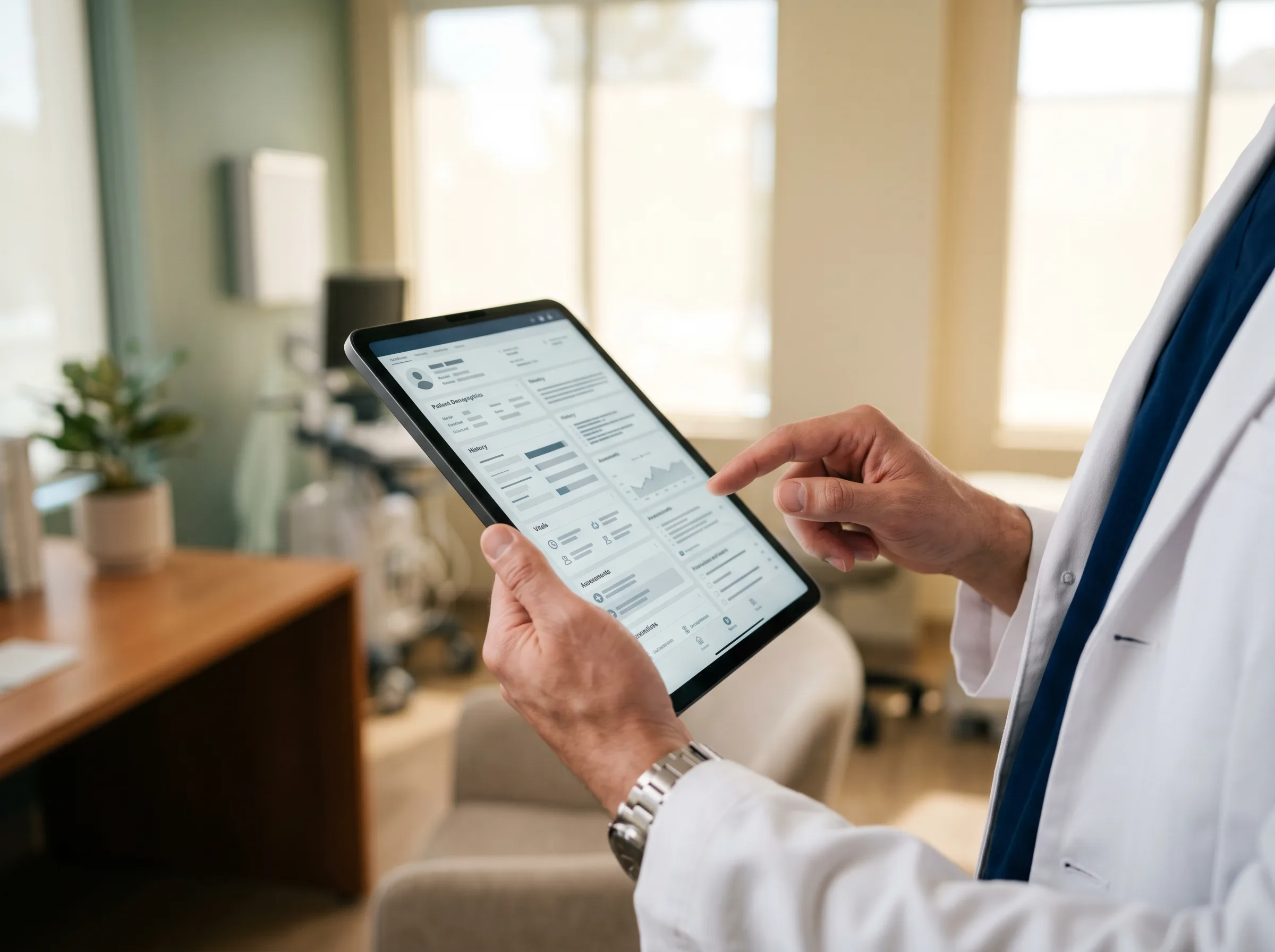
There’s a quiet objection that comes up whenever clinicians talk about AI documentation, and it rarely makes it into a product demo. It goes something like this: writing the note is part of how I think. The act of summarizing the encounter — deciding what matters, what to foreground, what to carry forward — is itself a clinical step. Hand that off, and you risk handing off the reasoning along with the typing.
It’s a serious objection, made by serious clinicians, and it deserves a better answer than “but it saves time.”
Why the note is more than a record
A clinical note looks like administrative output. It reads like paperwork — a transcript of decisions already made. But the experienced clinician knows the writing isn’t just a record of the thinking; it’s part of doing the thinking. Forcing the encounter into an assessment and a plan is where loose impressions get tested and resolved. The note is where “something’s off about this presentation” becomes a differential, and where the differential becomes a next step.
That’s why the strongest version of the objection isn’t nostalgia. It’s specific: clinicians describe coming back to an AI-generated note weeks later and not recognizing it — not because it was wrong, but because they never made the cognitive imprint that writing it themselves would have created. The note existed. The memory of reasoning through it didn’t.
If that’s what’s at stake, then “the AI writes your notes for you” is exactly the wrong promise. It optimizes the artifact and quietly removes the thinking the artifact was supposed to encode.
The fix isn’t avoiding AI — it’s keeping the physician in the loop
Here’s where the conversation usually stalls, framed as a binary: either you write every note by hand and keep the cognitive imprint, or you offload to a tool and lose it. Drown in charting, or drift away from your own reasoning.
That binary is false, and the way out of it is older than AI. It’s how teaching hospitals have always worked.
A senior resident takes the history, organizes what’s known, and drafts the note. The attending reviews it, corrects it, and signs it. The drafting is delegated; the reasoning and the responsibility are not. The attending still reads, still tests the assessment against what they saw, still owns the plan. The resident did the legwork — but the thinking was supervised, not surrendered.
That’s the model worth holding AI to. Not “the AI writes your notes,” but “the AI drafts, and you do what an attending does.”
What “review and own” actually requires
The distinction only holds if the workflow is built for it. “You can edit it afterward” is not the same as a model designed around physician ownership. The difference shows up in the details:
- The draft is a starting point, not a verdict. Claire gathers the intake and history and produces a first draft in your format — explicitly something to be reviewed, not a finished note presented as fact.
- The reasoning stays with you. Claire does the legwork around the encounter; the assessment, the plan, and the signature are yours. The judgment never leaves the physician — same as a resident handing a note to the attending.
- Review is a real step, not a rubber stamp. A note you actually read, test, and correct keeps the cognitive imprint the objection is worried about. The goal is to remove the transcription burden, not the thinking.
This is the line between offloading the work and offloading the responsibility — and only one of those is something a careful clinician should accept.

Why this matters more, not less, as the tools get better
It would be easy to treat this as a transitional worry — something that fades as models improve. The opposite is true. The better an AI draft looks, the more tempting it is to sign without really reading, and the easier it is to let the reasoning quietly migrate out of the physician’s hands. A clumsy tool forces you to engage. A fluent one makes disengagement frictionless.
So the safeguard can’t be model quality alone. It has to be the workflow: a tool that positions itself as a draft for your review, keeps you in the assessment and the plan, and never blurs the line between doing the work and making the call. The clinicians raising this objection aren’t being precious about paperwork. They’re protecting the part of documentation that’s actually clinical — and any tool worth adopting should protect it too.
The bottom line
Note-taking carries real clinical reasoning, which is exactly why “let the AI do it for you” is the wrong frame. The right frame is the one medicine already trusts: a capable junior does the drafting, a physician reviews and owns the result, and the thinking stays where it belongs.
The hours of after-hours charting are a genuine problem worth solving. But the solution is to take the transcription off your plate — not the judgment. Hold any AI documentation tool to that standard, and the objection stops being a reason to avoid AI. It becomes the spec for choosing the right kind.
Curious how Claire drafts the note while keeping you in control? See how Claire works, compare it on our AI scribe comparison hub, or book a demo.