

The last patient left at 5. The notes get finished at 9.
If that’s your day, you already know the feeling: dinner half-eaten, laptop open on the kitchen table, working through the charts you couldn’t touch while you were actually seeing patients. Clinicians have a name for it — “pajama time” — and it’s become such a fixture of medicine that most physicians treat it as a personal failing. If I were faster. If I were more organized. If I just stayed a little later.
It isn’t a personal failing. It’s a system that asks you to do two jobs at once and only gives you time for one.
The math doesn’t close
Here’s what the research has consistently found.
A landmark time-and-motion study published in Annals of Internal Medicine in 2016 — funded by the American Medical Association and led by Dr. Christine Sinsky — observed 57 physicians across family medicine, internal medicine, cardiology, and orthopedics. The headline finding: for every hour of direct clinical face time with patients, physicians spent nearly two additional hours on EHR and desk work during the clinic day. On top of that, the physicians who kept after-hours diaries reported another one to two hours of computer and clerical work every night at home. 1
A 2017 study in Annals of Family Medicine, again co-authored with the AMA, went further by pulling the actual EHR event logs of 142 family physicians over three years. It found they spent 5.9 hours of an 11.4-hour workday inside the EHR — and 86 minutes of that came after clinic hours, the literal “pajama time” the lead author named. 2
Read those numbers again. Two hours of documentation for every one hour with a patient. Six hours a day in the record. An hour and a half of it after you’ve gone home. The reason your notes finish at 9 isn’t that you’re slow. It’s that the work was never going to fit inside the day.
How the work got this way
None of this was designed on purpose. It accumulated.
Structured documentation requirements grew. Billing and coding moved onto the physician. Inbox messages, portal replies, prior authorizations, refill requests — tasks that a team used to absorb, or that simply didn’t exist — landed on the one person whose time is most expensive and least elastic. As Dr. Sinsky put it, work previously done by other team members got shifted to the physician, and “tasks that may have earlier required a matter of seconds now may each take one to two minutes.” Multiply that across a thousand small interactions a day, and you get a workday that quietly doubled. 3
So when documentation spills into the evening, the honest diagnosis isn’t try harder. It’s the workflow is broken. And you don’t fix a broken workflow with more willpower — you fix it by taking work off the clinician that never needed to be there in the first place.
Offloading the work — without offloading the judgment
This is exactly where the research points. Both AMA studies reach the same conclusion: the way out is to delegate the clerical load — documentation, order entry, history-gathering, inbox triage — to the rest of the care team so the physician’s hours go back to patients. The 2017 authors are explicit that EHR work “could be delegated, thus reducing workload, improving professional satisfaction, and decreasing burnout.” 2
The hard part has always been who does the delegating. Most practices don’t have a scribe in every room or an extra clinical assistant per physician. That’s the gap an AI clinical partner is built to close.
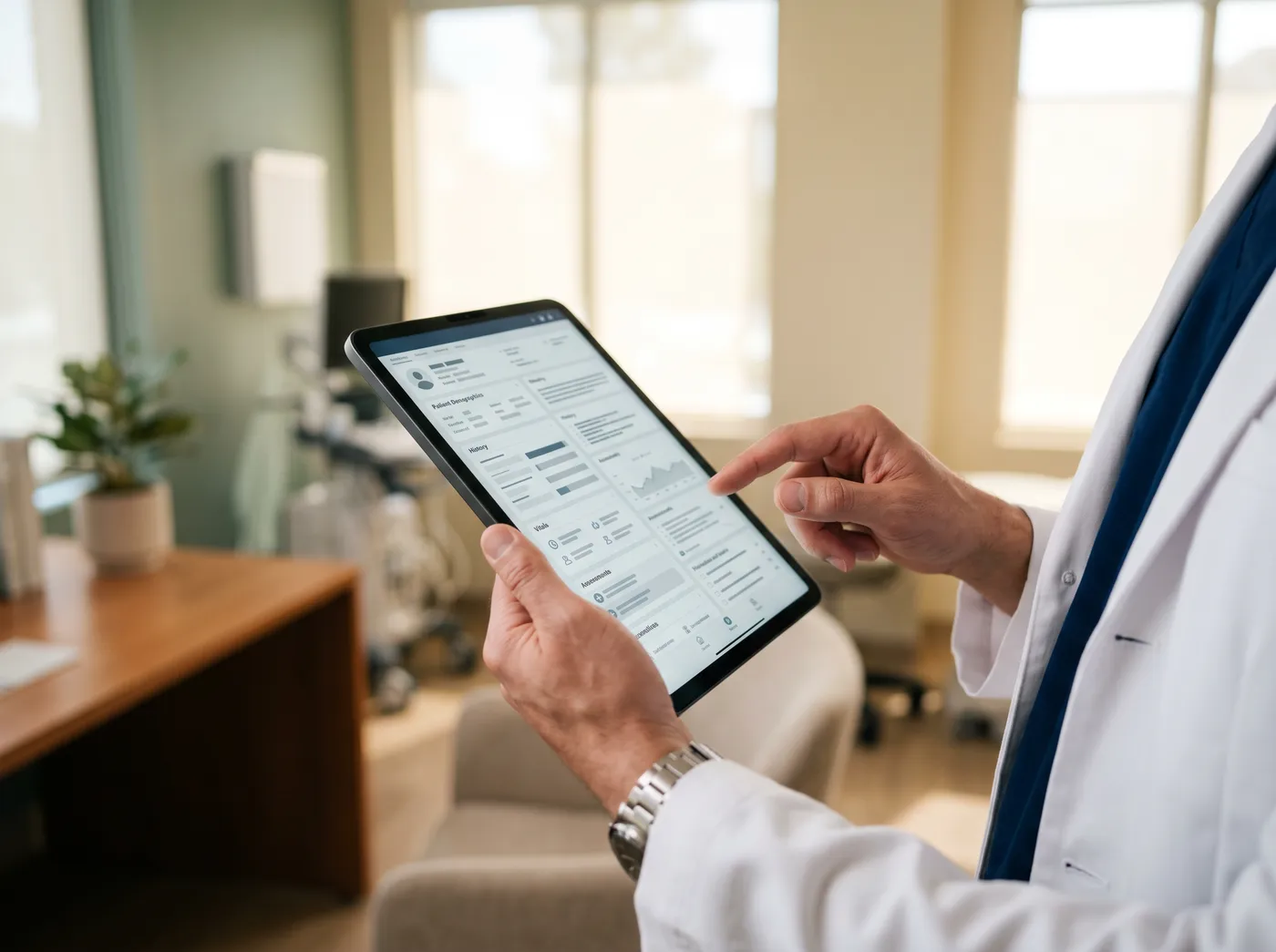
Claire is designed as an AI senior resident, not a recorder. Before the visit, Claire runs a structured patient intake and captures a complete history. During and after, it organizes the clinical data and drafts the note in your format — so the documentation is largely done by the time you sit down, instead of waiting for you at 9pm.
The word that matters there is drafts. A senior resident takes the history and writes the note; the attending reviews, corrects, and signs. The judgment never leaves the physician. Claire works the same way: it does the gathering and the first draft, you review and own every word. That’s the difference between offloading the work and offloading the responsibility — and only one of those is something a good clinician would ever accept.
What you actually get back
The point of closing the documentation gap isn’t to squeeze in more clicks faster. It’s to give the hours back to the part of medicine that needed a human in the first place — being present in the room, thinking through the hard case, getting home before the day is over.
The “pajama time” problem is real, it’s measured, and it’s not yours to carry alone. The notes finishing at 9 were never a verdict on you. They were a verdict on the workflow. That part, finally, is fixable.
Want to see how Claire handles intake, history, and the first draft of your note? See how Claire works, or book a demo.
Footnotes
-
Sinsky C, Colligan L, Li L, et al. “Allocation of Physician Time in Ambulatory Practice: A Time and Motion Study in 4 Specialties.” Annals of Internal Medicine, 2016. doi:10.7326/M16-0961. ↩
-
Arndt BG, Beasley JW, Watkinson MD, et al. “Tethered to the EHR: Primary Care Physician Workload Assessment Using EHR Event Log Data and Time-Motion Observations.” Annals of Family Medicine, 2017;15(5):419–426. doi:10.1370/afm.2121. ↩ ↩2
-
American Medical Association. “Family doctors spend 86 minutes of ‘pajama time’ with EHRs nightly.” 2017. ↩