

Ask a physician what they do all day and the answer is immediate: I see patients.
It’s the honest answer, and it’s the reason almost everyone goes into medicine. It’s also, by the numbers, not how most of the day is actually spent. When researchers stop asking physicians to estimate their time and instead measure it — with trained observers in the room and with the timestamped logs every EHR quietly keeps — a very different day appears. The patient is still at the center of it. They’re just no longer the majority of it.
This is the real anatomy of a physician’s day: where the hours go, why they go there, and what it would take to get some of them back.
The headline number: roughly half the day is the computer
Start with the most-cited measurement in the field. In a 2016 time-and-motion study published in Annals of Internal Medicine — funded by the American Medical Association and led by Dr. Christine Sinsky — trained observers shadowed 57 physicians across family medicine, internal medicine, cardiology, and orthopedics for 430 hours of clinic time.
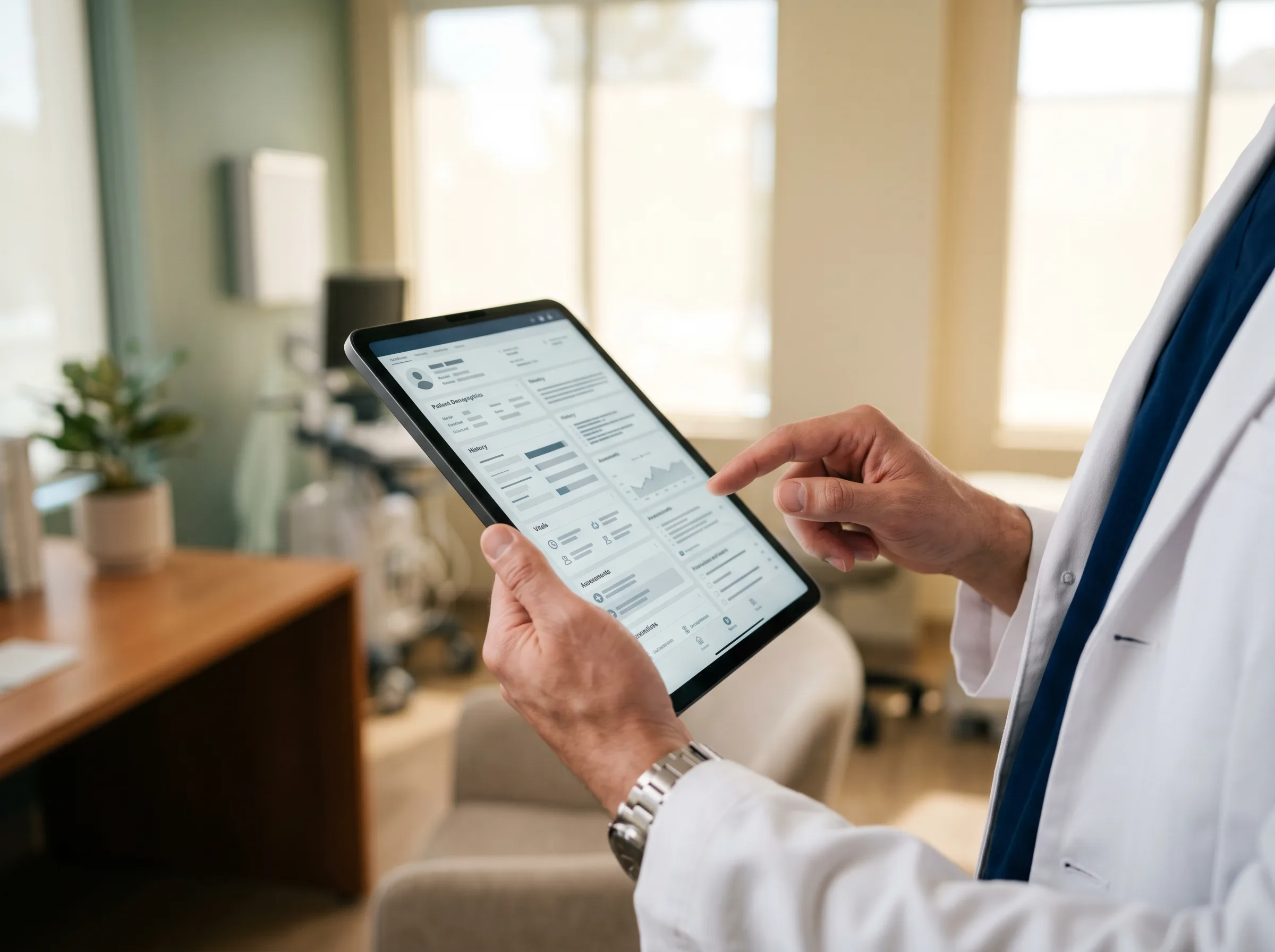
What they found: during the office day, physicians spent 27% of their time on direct clinical face time with patients and 49.2% on EHR and desk work. Even inside the exam room, with the patient sitting right there, only 52.9% of the time was face-to-face — 37% was spent on the computer. The one-line summary the study is famous for: for every hour of direct patient care, physicians spend nearly two more hours on the EHR and desk work during the clinic day. 1
A separate research group came at the same question from a completely different direction and landed in the same place. A 2016 Health Affairs study by Ming Tai-Seale and colleagues didn’t watch anyone — it analyzed over 31 million EHR transactions logged by 471 primary care physicians. Their split: 3.08 hours a day on office visits and 3.17 hours a day on “desktop medicine” — portal messages, refill requests, test-result review, orders, staff messages. Desk work didn’t just rival patient care; it slightly exceeded it. 2
Two studies, two methods, one conclusion: about half of a physician’s working time is spent with the record, not the patient.
Hour by hour: an 11.4-hour day, mapped
The most granular picture comes from a 2017 Annals of Family Medicine study that pulled three years of Epic event logs for 142 family physicians — over 118 million logged events — and validated them against direct observation. It’s the closest thing we have to a stopwatch on the whole day. 3
Here’s the day it describes, per physician, per clinical day:
- 11.4 hours — total workday length.
- 5.9 hours — spent inside the EHR, more than half the day.
- 4.5 hours of that during clinic hours.
- 1.4 hours (86 minutes) after clinic hours — the literal “pajama time.”
- Where the EHR time goes:
- 157 minutes (44%) on clerical and administrative tasks: documentation, order entry, billing and coding, system security.
- 85 minutes (24%) on inbox management alone — portal messages, results, refills, staff notes.
Sit with that inbox number for a second. Nearly an hour and a half every day, just triaging the messages that arrive whether or not a visit happens. In the same health system, the researchers watched portal encounters climb 62% over three years while actual visit volume held flat. The inbox is the part of the day that grows on its own. 3
Why the day looks like this — it accumulated, it wasn’t designed
None of this was anyone’s plan. It’s sediment.
Structured documentation requirements grew. Billing and coding moved onto the physician’s plate. Computerized order entry put every order through the doctor’s hands. Patient portals — genuinely good for patients — created a second, asynchronous clinic that never closes. And a long list of tasks that clinical staff used to absorb, or that simply didn’t exist a decade ago, drifted to the one person whose time is most expensive and least elastic. As Dr. Sinsky has put it, work once done by others shifted to the physician, and “tasks that may have earlier required a matter of seconds now may each take one to two minutes.” Multiply that across a thousand small interactions and a workday quietly doubles. 1
The result is the pattern every clinician recognizes: the visits fill the daylight hours, and everything about the visits — the note, the orders, the messages, the coding — stacks up behind them and waits until the patients leave. That’s why documentation finishes at 9pm. It was never going to fit inside the day, because the day was already full of patients before any of the desk work began. (We dug into the after-hours half of this specifically in why your notes finish at 9pm.)
The day is fixable — but only by removing work, not adding willpower
Here’s the genuinely hopeful part, and it comes straight out of the same research.
When investigators looked at why some physicians spend far less time in the record than others, the difference wasn’t speed or discipline. A 2023 JAMA Network Open study of 307 primary care physicians found EHR time varied enormously between doctors — and the things that drove it down were structural: greater team collaboration on orders, support staff who handled medication refills, a pharmacy technician in the clinic. Having the team share the order and refill load was associated with roughly 4 to 8 fewer minutes of EHR time per visit. Across a full panel, that’s hours. 4
In other words, the lever that works is taking the clerical load off the physician — exactly what the original AMA studies concluded. The 2017 authors said it plainly: EHR work like documentation, order entry, and inbox triage “could be delegated, thus reducing workload, improving professional satisfaction, and decreasing burnout.” 3
The catch has always been who does the delegating. Most practices can’t put a scribe in every room or hire an extra clinical assistant per physician. The work is real, it’s measured, and there simply aren’t enough hands.
Where an AI clinical partner fits in the anatomy
This is the specific gap Claire is built for — and it’s worth being precise about which hours it touches.
Claire is designed as an AI senior resident, not a recorder. Before the visit, it runs a structured patient intake and captures a complete history. During and after, it organizes the clinical data and drafts the note in your format. So the parts of the day that the log studies flag as the heaviest — history-gathering, documentation, the first draft — are largely done by the time you sit down, instead of waiting for you after the last patient leaves.
The word that matters is drafts. A senior resident takes the history and writes the first note; the attending reviews, corrects, and signs. The judgment never leaves the physician. Claire works the same way: it does the gathering and the draft, you review and own every word. That’s the line between offloading the work and offloading the responsibility — and only one of those is something a good clinician should ever accept.
Reclaiming even part of that 5.9 hours doesn’t mean cramming in more clicks. It means giving the time back to the part of the day that needed a human in the first place: being present in the room, thinking through the hard case, and getting home before the day is technically over.
The anatomy of the day isn’t a verdict on any physician. It’s a verdict on the workflow. And workflows, unlike willpower, can actually be changed.
Want to see how Claire handles intake, history, and the first draft of the note? See how Claire works, or book a demo.
Footnotes
-
Sinsky C, Colligan L, Li L, et al. “Allocation of Physician Time in Ambulatory Practice: A Time and Motion Study in 4 Specialties.” Annals of Internal Medicine, 2016;165:753–760. doi:10.7326/M16-0961. ↩ ↩2
-
Tai-Seale M, Olson CW, Li J, et al. “Electronic Health Record Logs Indicate That Physicians Split Time Evenly Between Seeing Patients And Desktop Medicine.” Health Affairs, 2017;36(4):655–662. doi:10.1377/hlthaff.2016.0811. ↩
-
Arndt BG, Beasley JW, Watkinson MD, et al. “Tethered to the EHR: Primary Care Physician Workload Assessment Using EHR Event Log Data and Time-Motion Observations.” Annals of Family Medicine, 2017;15(5):419–426. doi:10.1370/afm.2121. ↩ ↩2 ↩3
-
Rotenstein LS, Holmgren AJ, Horn DM, et al. “System-Level Factors and Time Spent on Electronic Health Records by Primary Care Physicians.” JAMA Network Open, 2023;6(11):e2344713. doi:10.1001/jamanetworkopen.2023.44713. ↩